
Executive summary
A creator can now research a topic, outline a video, generate subtitles, edit clips, and prepare promotional material in considerably less time than many of those tasks once required.
The productivity benefits of AI are becoming easier to document. The financial benefits are harder to separate from everything else happening inside a business.
In HubSpot's 2026 research, 67% of surveyed marketing teams reported saving at least 10 hours per week with AI. Gusto's small-business research also identified substantial self-reported productivity improvements, along with revenue gains among some businesses using generative AI.
Yet the financial experience of creators remains uneven. NeoReach found that more than half of the creators it surveyed earned under $15,000 annually. CreatorIQ's analysis of brand and agency campaign payments found that the top 10% of recipients accounted for 62% of payment volume.
These studies examine different populations and cannot tell us whether AI is increasing the profitability of independent creators. They do suggest that we need to examine the relationship between productivity and business performance more carefully.
KEXR reviewed research on creator compensation, AI adoption, business skills, marketing performance, and consumer expectations to explore that relationship. AI can create additional capacity. What happens to that capacity depends on the work being improved, the business behind it, and how success is measured.
1. AI is changing the cost of getting work done
For an independent creator, time is often the most limited resource. Recording videos, preparing product listings, researching topics, managing customers, maintaining a website, and publishing across platforms can consume the working week before much attention is given to improving the business itself.
AI is reducing the effort required for some of those activities.
Adobe's June 2026 research examined changes in creative work through surveys, employment data, and interviews. Its findings suggest that AI is being incorporated into particular stages of creative production, especially brainstorming and early development, while creators continue to place value on their own judgment and creative direction. Among the U.S. creative professionals surveyed, 84.8% reported positive sentiment about AI's role in brainstorming and ideation. [1]
HubSpot reported similar enthusiasm for AI's practical benefits. Its 2026 State of Marketing survey included 1,505 marketers across several regions. Of those surveyed, 67% said AI saved their teams at least 10 hours per week, and 68% reported meaningful productivity improvements. [2]
These findings concern creative professionals and marketing teams, not a representative sample of independent creators. Still, the applications are familiar to anyone producing content regularly. A solo creator can generate a first draft more quickly. A video producer can automate captions. Someone selling products online can use AI to organize customer feedback or prepare variations of product descriptions.
The time savings can be useful even when revenue does not immediately change. A creator may choose to work fewer hours, improve the quality of an existing product, or spend more time with customers.
But if production becomes easier for one creator, it becomes easier for competing creators, too. Publishing additional content may no longer provide the same distinction it once did. The advantage comes partly from what the creator does with the time that becomes available.
2. More investment in creators does not mean everyone is earning more
Commercial investment in creator marketing has grown substantially. The Interactive Advertising Bureau projected that U.S. creator-related advertising expenditure would reach $37 billion in 2025, an increase of 26% from the previous year. That figure includes creator partnerships, amplification, and related advertising activity. It should not be confused with the total income creators received. [3]
Research focused on individual earnings presents a different picture.
NeoReach surveyed more than 3,000 creators for its 2025 Creator Earnings Report. Of those respondents, 50.71% reported earning less than $15,000 annually. [4]
Later's Creator Compensation Report found that 51% of its 689 surveyed U.S. social creators earned less than $500 monthly from content. The sample was heavily female and focused on creators active on social platforms, so its findings should not be treated as representative of all creator businesses. [5]
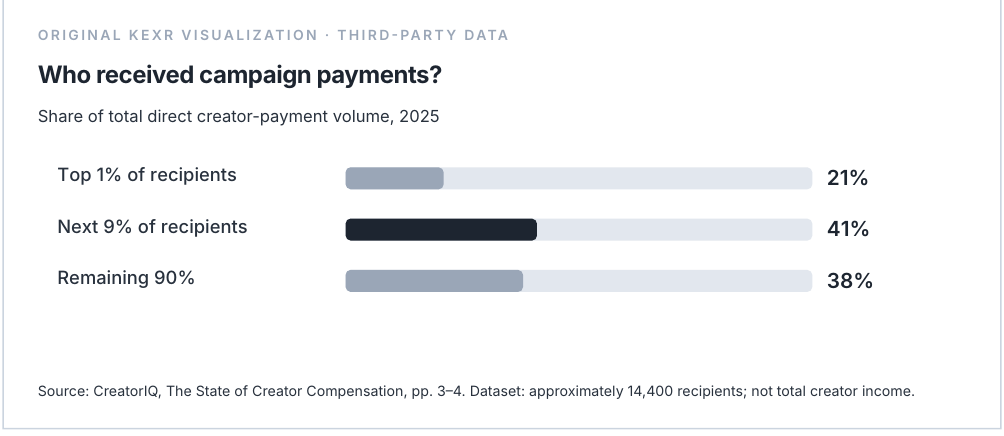
CreatorIQ offers a separate view of compensation through actual campaign-payment records. Its analysis covered approximately 14,400 creators who received direct payments from brands or agencies during 2025. The average payment total was approximately $11,400 per creator, while the median was approximately $3,000. The top 10% of creators received 62% of the total payment volume. [6]
The CreatorIQ figures cover payments in its campaign dataset, not every source of income those creators may have had.
These differences in methodology matter. A survey of annual creator earnings cannot be directly combined with a dataset of brand-campaign payments. Nor should findings about social influencers automatically be applied to creators selling software, consulting services, physical products, or memberships.
Even with those limitations, the studies establish an important point: income is distributed unevenly across the creator economy. A creator may be producing good work and attracting an audience without having developed a business that generates consistent income.
Faster production may help someone reach more people. Whether those people become customers depends on what the creator offers, whom it serves, and how the business operates.
Who received campaign payments?
Share of direct creator payments in 2025: top 1% of recipients, 21%; next 9%, 41%; remaining 90%, 38%. CreatorIQ campaign dataset of approximately 14,400 recipients; not total creator income.
3. What does a good return on AI actually look like?
Neil Patel's research through NP Digital provides an interesting perspective on where organizations report financial benefits from AI.
In December 2024, NP Digital published an analysis of 119 corporations with annual revenue of at least $10 million. Content creation was the most common AI application measured in the study, accounting for 24.4% of reported usage. Its reported return on investment was 11.8%. Automation tasks accounted for only 6.1% of usage but were associated with a reported ROI of 68.8%. [7]
Those numbers are worth examining, although the publicly available methodology does not provide enough detail to establish how the returns were calculated or how they would translate to smaller creator businesses. We should not conclude that automation will return 68.8% for an independent creator, or that content creation is a poor AI investment.
The more useful question is why different applications may produce different outcomes.
Consider a creator who spends several hours each week preparing social posts. AI may reduce the time considerably. That has value. But if the creator already publishes consistently and the additional posts produce little additional interest, the financial return may be limited.
Now consider someone who has steady customer demand but spends much of the working day answering the same questions, managing appointments, and handling routine administration. AI-assisted systems might help that person serve existing customers more efficiently, respond to inquiries faster, or free time for additional paid work.
Both creators benefit from increased productivity. The effect on their businesses may be different.
Gusto's small-business research is useful because it provides evidence of benefits beyond time savings. Its AI for Small Business report found that four in five businesses using generative AI reported productivity improvements of at least 20%. Forty percent reported revenue gains of at least 20% that they attributed to AI. [8]
These are self-reported results from small businesses, and the published material does not establish a controlled causal effect. Nevertheless, they challenge the assumption that AI only makes work faster. Some businesses report meaningful commercial gains.
There is also an important distinction between revenue and profit. A business can increase sales while spending more on advertising, software, customer support, or fulfillment. Revenue growth alone does not tell us whether its profit margin improved.
Before adopting another AI tool, it may be more useful to ask which part of the business needs attention and what improvement would count as a successful result.
4. Being good at content is different from managing a business
Creators often learn their craft by doing it. They experiment with formats, study how audiences respond, develop their own production methods, and gradually improve their work. Business skills may develop less systematically.
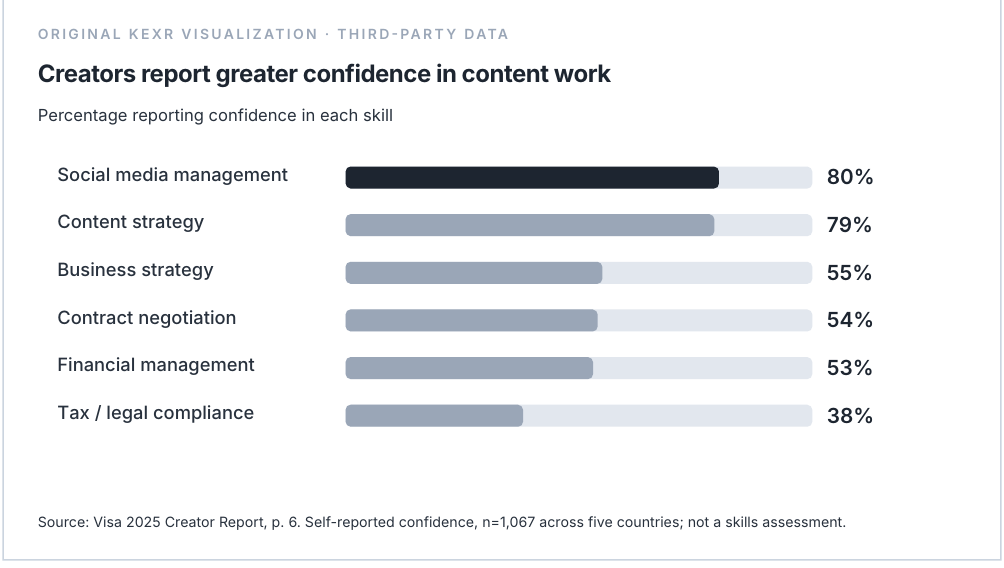
Visa's 2025 Creator Report surveyed 1,067 creators across the United States, Brazil, Australia, the United Kingdom, and the United Arab Emirates. Respondents expressed high confidence in social media management (80%) and content strategy (79%). Confidence was lower in business strategy (55%), contract negotiation (54%), financial management (53%), and tax or legal compliance (38%). [9]
The survey measured confidence, rather than testing ability. It would be wrong to interpret those percentages as proof that creators lack the relevant skills.
But the training findings help explain why business management deserves attention. Seventy-one percent of respondents said they were self-taught or had no training in financial management. Seventy-six percent reported the same for contract negotiation.
These areas can affect how much of a creator's revenue becomes usable income. A creator selling sponsorships needs to understand compensation terms and usage rights. Someone selling digital products needs to price those products with transaction fees, customer support, and production costs in mind. A service provider needs to understand the cost of fulfilling client commitments.
AI can assist with research, recordkeeping, calculations, and administrative preparation. Professional review remains necessary when legal, tax, or other consequential decisions are involved.
A creator who has already solved a production problem may gain more from learning how to price an offer, improve a sales process, or understand monthly cash flow than from publishing more frequently. That is a decision worth making before investing additional hours in content.
Creators report greater confidence in content work
Creator confidence: social media 80%, content strategy 79%, business strategy 55%, contracts 54%, financial management 53%, tax/legal 38%. Visa 2025 survey, n=1,067; confidence is not a skills assessment.
5. When everyone has access to AI, what is harder to copy?
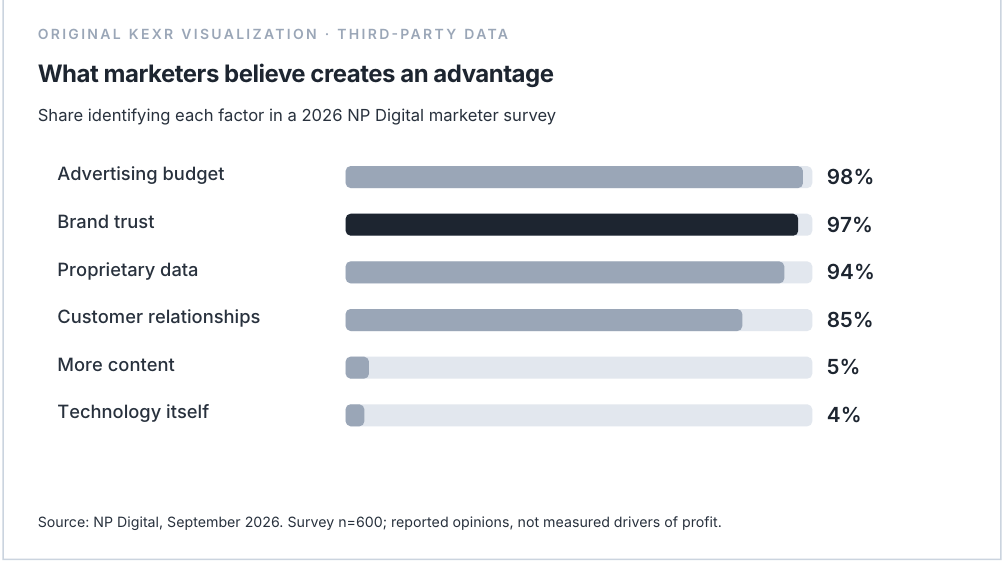
In September 2026, NP Digital surveyed 600 marketers about competitive advantage in an environment where AI tools are widely available. Ninety-seven percent identified brand trust as a source of competitive advantage, 94% identified proprietary data, and 85% identified customer relationships. Only 5% selected the ability to produce more content, and 4% selected the technology itself. [10]
These figures reflect what marketers believe creates an advantage. They do not independently measure how much profit each factor generates.
Many people can now use the same writing assistants, image generators, editing tools, and automation platforms. What they cannot automatically reproduce is another creator's experience with customers, firsthand research, relationships, or accumulated knowledge of a particular subject.
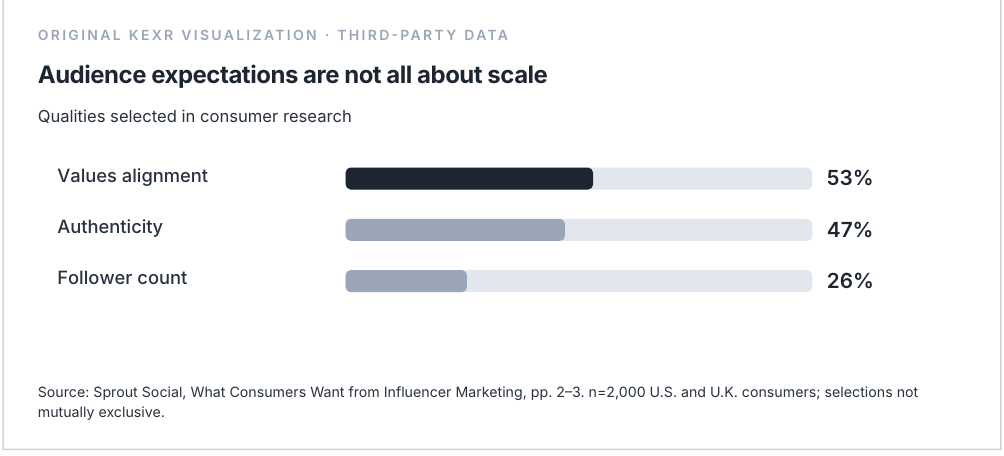
Consumer research adds context. Sprout Social surveyed 2,000 consumers in the United States and United Kingdom about influencer marketing. Among respondents, 53% selected alignment with personal values as an important influencer quality, 47% selected authenticity, and 26% selected follower count. [11]
Those preferences were not uniform. Among Gen Z respondents, 47% emphasized follower count and 35% selected authenticity. Audiences do not all evaluate creators in the same way.
Originality, trust, and expertise matter differently across audiences and content categories. Someone watching a gaming creator may value entertainment, skill, and personality. A customer considering consulting may pay closer attention to experience and evidence. A person joining a membership community may care most about participation and the people involved.
AI can improve how these creators communicate. It cannot supply all the qualities audiences are looking for.
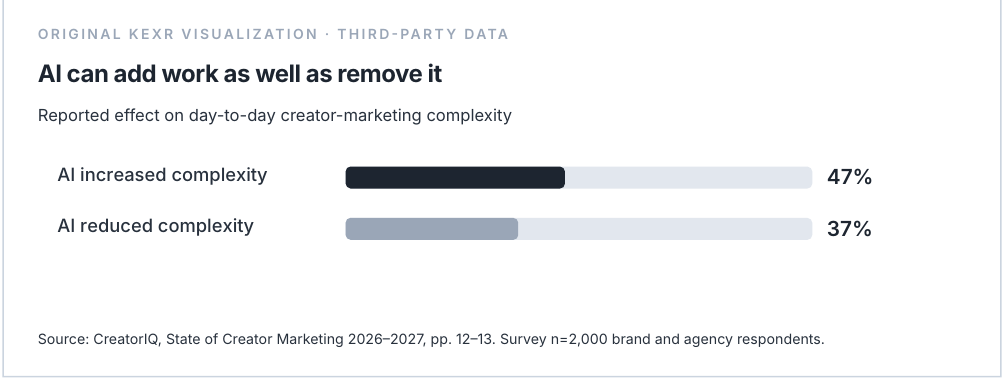
There is another complication. CreatorIQ's 2026-2027 research surveyed 2,000 brands and agencies. Forty-seven percent said AI had increased the day-to-day complexity of creator marketing, while 37% said it had reduced complexity. [12]
AI introduces efficiencies, but it can also create work in reviewing output, managing tools, maintaining accuracy, and coordinating processes. An output that takes five minutes to generate but an hour to verify may be less efficient than it first appears.
What marketers believe creates an advantage
Marketers citing competitive advantages: advertising budget 98%, brand trust 97%, proprietary data 94%, customer relationships 85%, more content 5%, technology 4%. NP Digital, September 2026, n=600; opinions, not measured profit drivers.
AI can add work as well as remove it
AI increased creator-marketing complexity for 47% and reduced it for 37% of respondents. CreatorIQ State of Creator Marketing 2026–2027, survey of 2,000 brand and agency respondents.
Audience expectations are not all about scale
Influencer qualities selected by consumers: values alignment 53%, authenticity 47%, follower count 26%. Sprout Social survey, n=2,000 U.S. and U.K. consumers; selections are not mutually exclusive.
6. KEXR analysis: what happens after the time is saved?
The studies reviewed for this paper measure different things. Some examine how much creators earn. Others look at time saved through AI, the returns organizations report, or the qualities audiences value. None provides a complete picture of how AI changes the net profitability of an independent creator business.
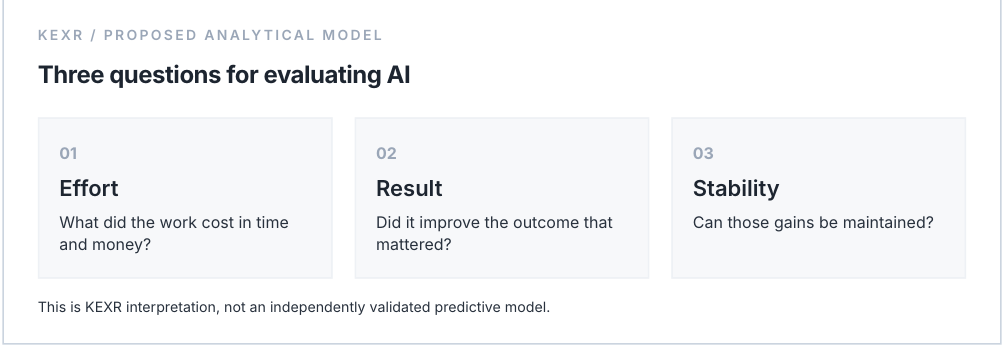
KEXR proposes evaluating three parts of the business:
The work itself. How much time and money does it take to produce, publish, deliver, and maintain what the creator offers?
The outcome. Does that work generate the intended result, such as meaningful audience participation, customer inquiries, purchases, or repeat business?
The ability to maintain it. Can the creator continue achieving those results at a reasonable cost and workload?
This is an analytical framework developed by KEXR from the reviewed research. It has not been tested as a predictive model. Its value lies in encouraging a more complete assessment.
Imagine a creator who sells downloadable templates. AI makes it possible to produce new templates and marketing material much faster. That may be useful if customers are requesting additional products and the creator has struggled to meet demand.
But if the existing templates receive plenty of visitors and very few purchases, producing more products may not address the immediate problem. The creator may need to understand customer expectations, improve product descriptions, review pricing, or test a different offer.
Now consider someone running a paid community. The challenge may be responding to members, preparing resources, and maintaining a useful experience as membership grows. AI could support those activities without requiring the creator to publish more public content.
In both examples, the value depends on the business problem being addressed.
KEXR uses five stages to help organize these decisions. Creators who are Starting may benefit from faster experimentation and customer research. Those gaining Traction may need to understand which audiences respond to their work. Creators who are Monetizing may need to improve their offers and sales processes. Businesses focused on Stabilizing or Scaling may find greater value in repeatable systems, retention, and operational efficiency.
These are working recommendations, not measured differences in AI performance by creator stage. Individual circumstances still matter more than a stage label.
Three questions for evaluating AI
KEXR framework: effort—what did the work cost in time and money? Result—did it improve the outcome that mattered? Stability—can those gains be maintained? KEXR interpretation, not an independently validated predictive model.
7. Essential statistics and key findings
The following figures come from separate studies; they are presented together for convenient reference, not as one combined benchmark.
- 67% of HubSpot's surveyed marketing teams reported saving 10 or more hours weekly using AI. [2]
- 50.71% of NeoReach's surveyed creators reported earning under $15,000 annually. [4]
- 62% of direct campaign-payment volume in CreatorIQ's 2025 dataset went to its top 10% of recipients. [6]
- 53% of Visa's surveyed creators reported confidence in financial management. [9]
What these figures suggest:
- AI produces real productivity gains. Studies of creative work, marketing teams, and small businesses document substantial benefits, although the reported improvement varies by use case and population.
- Some businesses report revenue gains. Those results matter, but revenue is not net profit, and the available self-reported findings do not prove causation.
- Creator income remains uneven. Survey and campaign-payment data show considerable variation. The studies do not establish AI as the cause of that variation.
- Business skills deserve attention. Many creators report less confidence and less formal training in financial and commercial activities than in content-related work.
- Additional content is not a universal competitive advantage. Trust, distinct experience, customer understanding, and original research may be harder to copy than the use of an AI tool.
8. What creators can do in 30 days
Creators do not need an elaborate measurement system to begin examining whether AI is helping their business. A focused test can provide more useful information than adding several tools at once.
Choose one problem. Select a recurring task that consumes time, creates avoidable costs, limits customer service, or prevents the business from improving. Describe the problem before deciding which tool to use.
Record a baseline. Measure how long the work takes and what it produces. Depending on the activity, that may include hours spent, inquiries answered, orders fulfilled, customer response times, or revenue associated with the process.
Test one AI-assisted approach. Use it for a defined period. Include time spent reviewing, correcting, and maintaining the output. A workflow is only faster if those costs are included.
Compare and decide. Did the process take less time? Did quality remain acceptable? Did the change improve the intended result? Keep, adjust, or discontinue the workflow based on what happened.
A creator may find that an AI application saves time without affecting revenue. That does not automatically make it unsuccessful. Reduced workload can be worthwhile in its own right. The important thing is to know what benefit was intended and whether it occurred.
Conclusion
AI has made an important part of running a creator business easier. For people working alone or with small teams, that matters. More work can be completed without adding equivalent production hours, and some businesses are already reporting financial benefits.
But efficiency leaves a decision for the person running the business. They can use additional capacity to publish more, improve what they sell, understand customers, reduce costs, or work fewer hours. Those choices have different purposes. Their value should be measured accordingly.
For creators preparing for 2027, a useful starting point is to examine where time is being spent and whether that work is producing the intended result.
If AI makes the wrong activity faster, the business may see little improvement. If it helps solve a problem that has been holding the business back, the effect can be considerably more valuable.
The question worth asking is what the creator needs to accomplish next, and whether AI helps accomplish it.
Methodology & limitations
This publication is a secondary research synthesis prepared by KEXR. The underlying surveys and datasets were collected by the organizations cited below. KEXR did not conduct new fieldwork for this publication. The analysis draws on creator-income surveys, campaign-payment data, marketing research, creative-work studies, consumer surveys, and small-business research. Sources differ in geography, sample design, population, and definitions of financial outcomes. Percentages from different studies have not been pooled into an overall estimate. Creator earnings, campaign payments, revenue growth, and net profitability are separate measures. Results reported for corporate marketers or small businesses should not be assumed to apply directly to independent creators. Self-reported results are identified where relevant. Associations between AI adoption and business performance are not presented as proof of causation. KEXR's proposed framework and stage recommendations are interpretations of the reviewed evidence, not independently validated empirical findings.
Sources & further reading
- Adobe Research (June 2026). The Future of Creative Work, Vol. 1: How AI Is Redistributing Creative Work.
- HubSpot (2026). State of Marketing Report. Survey conducted September 2025, n=1,505.
- Interactive Advertising Bureau (November 2025). 2025 Creator Economy Ad Spend & Strategy Report.
- NeoReach (2025). Creator Earnings Report. More than 3,000 creators surveyed.
- Later. Creator Compensation Report. Survey of 689 U.S. social creators.
- CreatorIQ. The State of Creator Compensation. Survey of 300 creators and separate direct-payment analysis of approximately 14,400 creators in 2025.
- NP Digital (December 2024). How Marketers Use AI and What Actually Pays Off.
- Gusto. AI for Small Business: A Data-Driven Guide to Start, Scale, and Succeed with AI.
- Visa and Morning Consult (2025). Monetized: Visa 2025 Creator Report. Survey of 1,067 creators.
- NP Digital (September 2026). When Everyone Has AI, What Actually Creates Advantage?
- Sprout Social. What Consumers Want from Influencer Marketing. Survey of 2,000 U.S. and U.K. consumers.
- CreatorIQ (2026). The State of Creator Marketing 2026-2027. Survey of 2,000 brands and agencies.